
A New Kind of Deal for the AI Era
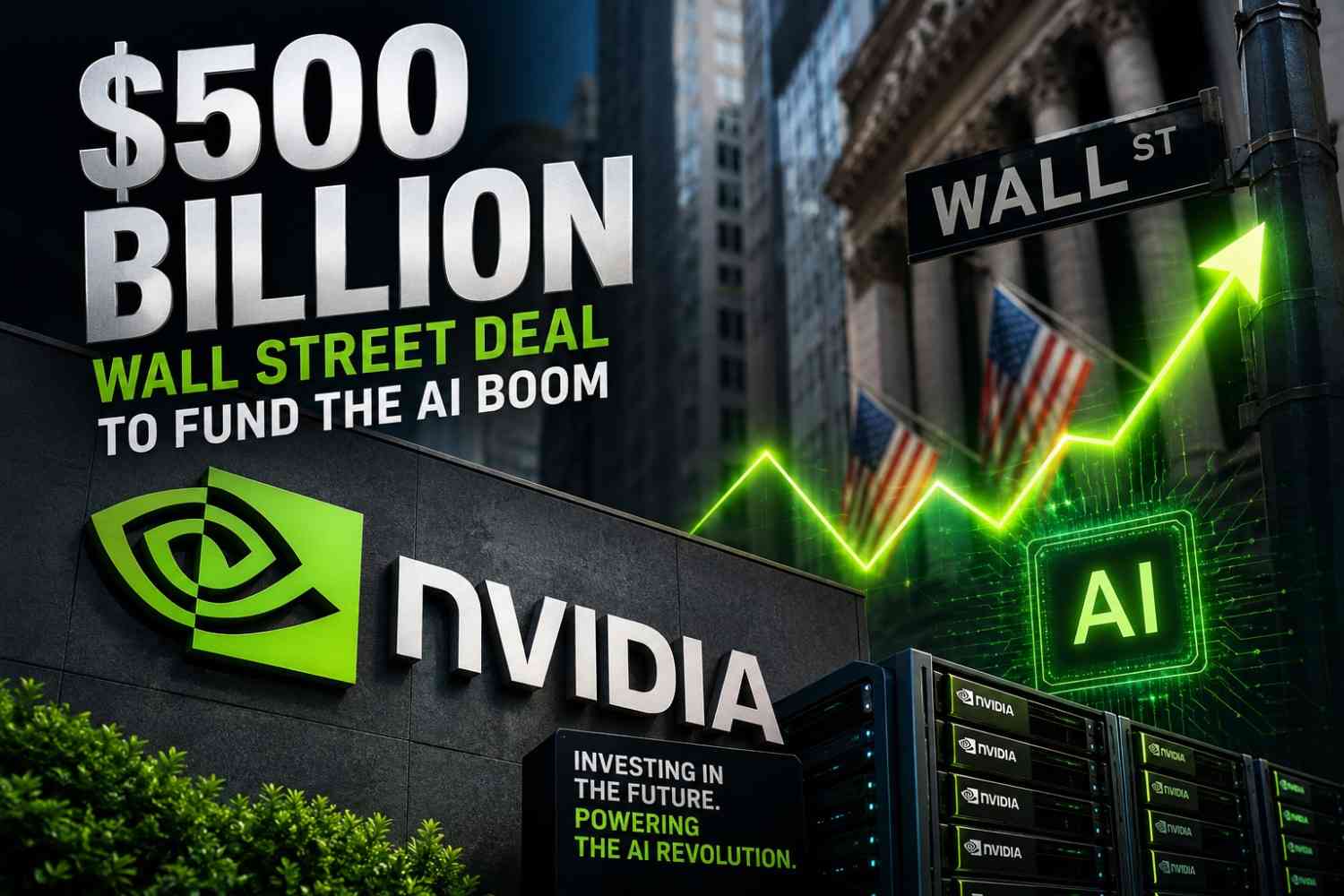
Nvidia has unveiled one of the most ambitious financing arrangements in the history of the technology industry, teaming up with six of Wall Street’s largest asset managers to mobilize more than $500 billion in outside capital for the buildout of artificial intelligence infrastructure. The chipmaker announced strategic partnerships with Apollo Global Management, BlackRock, Blackstone, Brookfield Asset Management, Goldman Sachs, and KKR to establish independent financing platforms aimed at Nvidia’s growing base of enterprise and government customers.
The scale of the commitment underscores just how central Nvidia has become to the broader AI economy — and how eager the world’s largest pools of institutional capital are to gain exposure to it. Collectively, the six partner firms oversee trillions of dollars in assets, ranging from Apollo’s roughly $1 trillion under management to Blackstone’s more than $1.3 trillion spread across real estate, credit, and infrastructure investments.
Turning Computing Power Into an Asset Class
At the heart of the arrangement is a relatively novel idea: treating AI computing capacity the same way investors have long treated toll roads, power plants, or commercial real estate — as a physical asset that can be financed, collateralized, and held for steady, long-term returns. Under the new platforms, Nvidia’s compute infrastructure and hardware essentially become the backbone of an investable product, allowing institutional investors to fund the “AI factories” that power everything from chatbots to enterprise software without necessarily taking on Nvidia’s own corporate risk.
Importantly, Nvidia itself is not acting as a lender in these arrangements. Instead, each of the six partner firms will independently underwrite and deploy capital through its own platform, connecting Nvidia’s customer base — companies and governments looking to build out massive data center campuses — with financing at a scale few individual firms could offer alone. Nvidia’s chief executive said the company approached only these six firms for the commitment, and all six agreed to participate.
Part of a Broader Financing Wave
The announcement doesn’t exist in isolation. It arrives in the same stretch in which Nvidia separately committed billions of dollars to an energy company tied to a major AI data center initiative and took a substantial equity stake in a separate energy firm, moves that together paint a picture of a company racing to secure the power and capital needed to keep pace with surging demand for AI infrastructure.
Alternative asset managers, for their part, have been eager to deploy capital into digital infrastructure for some time, tapping into institutional and insurance-linked funding sources to back similarly large projects. Some of the same firms involved in the new Nvidia platforms have already helped structure financing for other major players in the AI space.
The timing is notable for another reason: the announcement comes on the heels of a rocky stretch for global markets in July, when investors began openly questioning whether the enormous capital expenditures being poured into AI by big technology companies would ultimately pay off. By shifting a portion of that financing burden onto specialized asset managers rather than corporate balance sheets, industry analysts say Nvidia and its partners may be trying to reassure markets that the AI buildout rests on a more diversified — and more disciplined — financial foundation.
What Comes Next
The agreements announced this week are memorandums of understanding rather than finalized deals, meaning the structures could still evolve before capital actually begins flowing. Executives involved in the plan have indicated they expect the platforms to move toward execution within the coming months.
If the arrangement plays out as designed, it could reshape how AI infrastructure gets built for years to come — turning what has largely been a story of tech giants spending down their own cash reserves into one where global institutional capital, from pension funds to insurance companies, becomes a permanent fixture in financing the AI economy. For an industry still working out how to sustainably fund its own explosive growth, that shift could prove just as significant as any single new chip release. Next Article