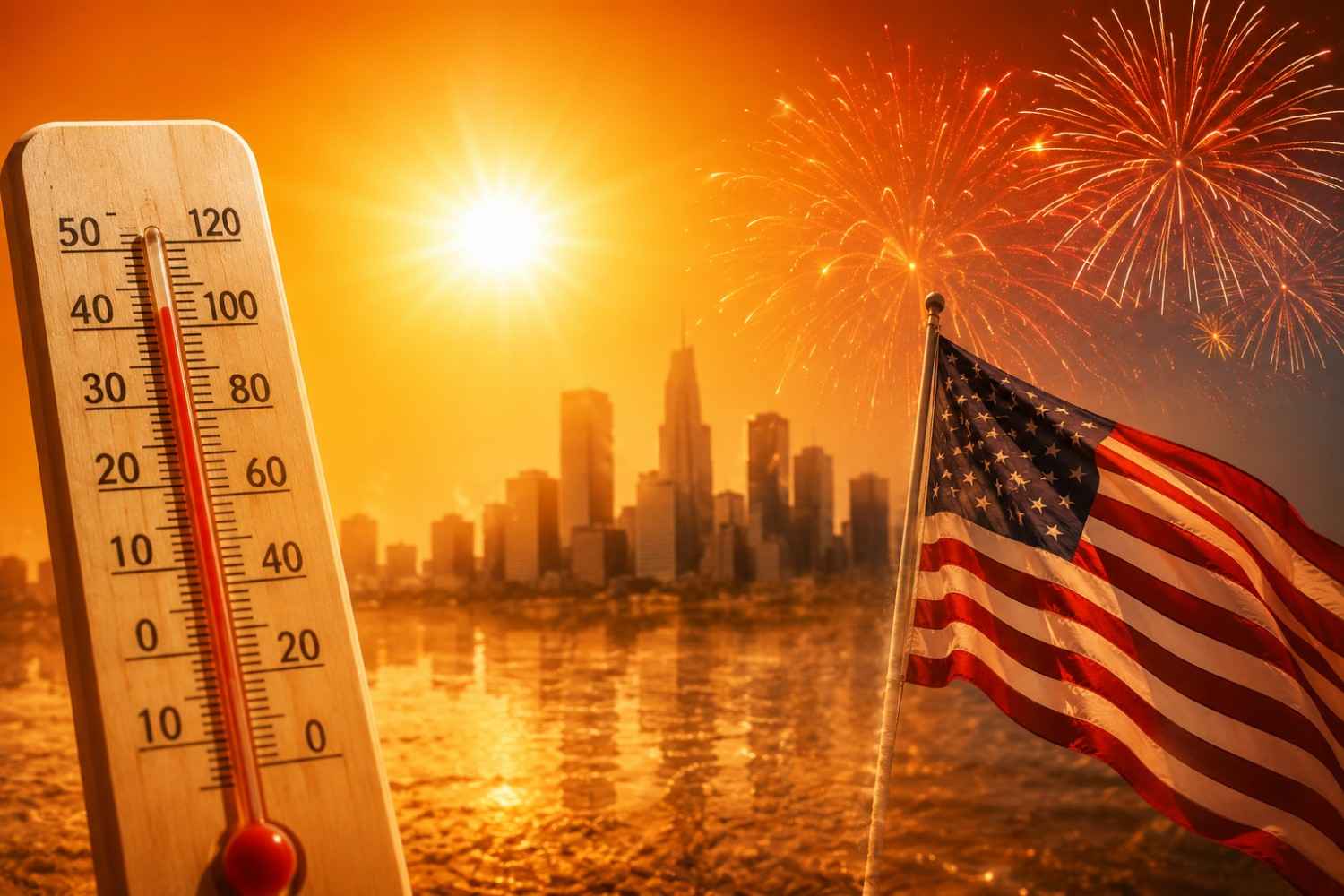
If you’re grilling out this Fourth of July anywhere between the Midwest and the East Coast, you might want to move the party indoors. A brutal heat dome has parked itself over more than half the country, and forecasters are warning this could be the hottest Independence Day on record for millions of Americans.
Washington, DC is staring down the possibility of hitting 103 degrees on the holiday itself, which would blow past the old record of 100 set all the way back in 1919. Meteorologists say the stretch from Thursday through Saturday could end up being the capital’s hottest three-day run since 1930. Philadelphia isn’t far behind, with highs pushing toward 104, and New York City already tied its 1966 record of 100 degrees on Thursday — the first time Central Park has hit triple digits in fourteen years.
It’s not just the daytime highs that have officials worried. Humidity is dragging the heat index — basically what the air actually feels like on your skin — well past 110 degrees in some spots, and overnight lows aren’t dropping enough to give anyone real relief. Doctors will tell you that’s often the more dangerous part of a heat wave, since bodies never really get a chance to cool down and recover.
Cities up and down the East Coast are scrambling to respond. New York has opened hundreds of cooling centers, including the massive Javits Convention Center, and is sending out mobile medical vans to hand out water and check on vulnerable residents. Boston’s mayor has asked people to simply reschedule outdoor plans. Washington’s National Park Service is urging anyone heading to the National Mall for the America250 celebrations to load up on sunscreen, find shade whenever possible, and know their limits. Even the power grid is under strain — the Department of Energy issued emergency orders this week to bring extra electricity generation online across the Mid-Atlantic before demand spikes any further.
Out west, it’s a different kind of danger. Dry conditions and gusty winds have sparked wildfires in Utah and southern Colorado, with red flag warnings in effect through the weekend.
Scientists studying the pattern point to a mix of factors — a stubborn high-pressure system trapping hot air in place, combined with record ocean temperatures that are only adding fuel to the fire. Climate researchers have been saying for years that heat waves like this one are becoming more frequent and more intense, and this Fourth of July is shaping up to be another data point in that trend. For now, the advice from health officials is simple: stay hydrated, stay in the shade, and check on your neighbors, especially older folks and anyone without reliable air conditioning.