
A Predicted Impact, Still Worth Watching
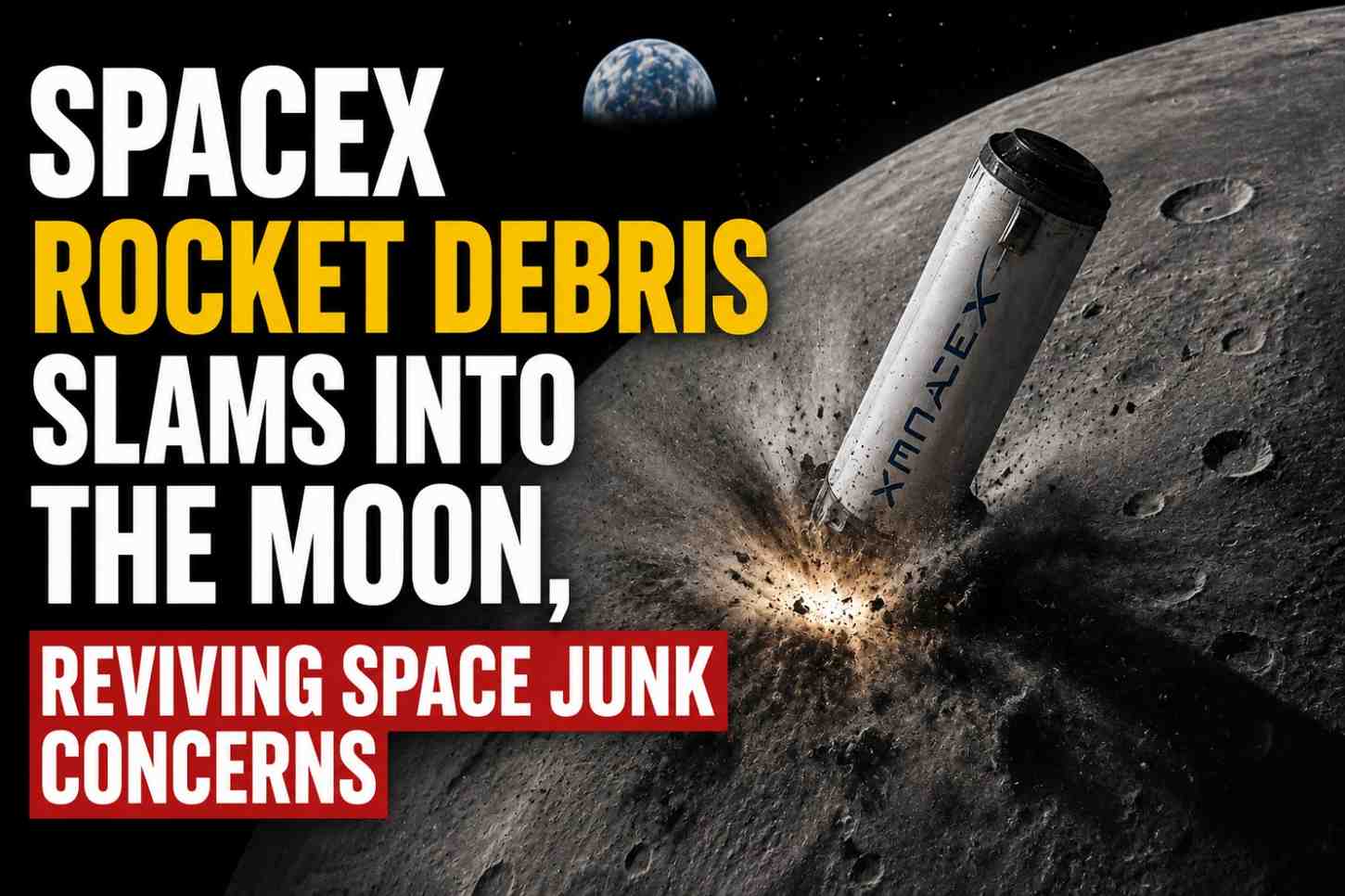
Early last Wednesday morning, while most of the country slept, a four-ton chunk of metal that once helped launch a SpaceX rocket toward the moon completed its journey in dramatic fashion — slamming into the lunar surface at roughly 5,400 miles per hour. The impact, which occurred near the moon’s Einstein Crater on its far side, was invisible from Earth but has become one of the more closely watched space stories of the summer.
The object was the upper stage of a Falcon 9 rocket that launched in January 2025, carrying a pair of lunar landers on a mission toward the moon. After completing its job, the stage remained adrift in space for nearly seven months, following what astronomers describe as a chaotic, unpowered trajectory before gravity ultimately pulled it toward a lunar collision.
How Scientists Saw It Coming
Unlike many pieces of space debris, this particular impact wasn’t a surprise. Independent astronomers had been tracking the roughly 45-foot-long rocket stage for months, using publicly available orbital data to calculate that a collision with the moon was all but inevitable. By the time it struck, on August 5 at around 2:35 a.m. Eastern time, researchers and space agencies around the world were ready with instruments trained on the predicted impact zone.
The European Southern Observatory’s Very Large Telescope was among the instruments watching closely. In the minutes following impact, the telescope detected spectral signatures of sodium and lithium in the debris plume kicked up by the collision — sodium believed to have originated from lunar soil disturbed by the crash, and lithium likely coming from the rocket stage itself. Observers say the plume was visible in their data for five to ten minutes before dissipating.
A Rare Opportunity for Scientific Study
While unplanned rocket debris hitting the moon might sound alarming, scientists have largely treated the event as a rare research opportunity rather than a catastrophe. Because the moon lacks the protective atmosphere that burns up most debris approaching Earth, any object on a collision course simply strikes the surface directly — making predictable events like this one valuable for studying impact dynamics that are otherwise difficult to observe.
Researchers are hoping to use data from the crash to better understand how future debris impacts might be detected seismically and to gain insight into the kinds of hazards that debris could eventually pose to lunar infrastructure and astronauts, as space agencies push forward with plans for a more permanent human presence on the moon. Lunar orbiters positioned to photograph the region are expected to provide before-and-after imagery of the new crater in the coming days, once lighting conditions and orbital timing allow.
A Growing Debris Problem
The incident adds to a lunar debris tally that has been steadily climbing as more countries and private companies launch missions toward the moon. Unlike Earth orbit, which has increasingly sophisticated tracking systems for space junk, there is currently no formal, coordinated system for monitoring debris once it leaves Earth’s immediate vicinity. Objects like the Falcon 9 stage are typically identified and tracked by astronomers searching for potentially hazardous asteroids, who happen to notice artificial objects along the way rather than through any dedicated debris-tracking program.
Experts have warned that as lunar traffic increases — with NASA advancing its long-term plans for a sustained human presence on the moon, and other nations and private companies ramping up their own missions — the risk of future, less predictable collisions will only grow without better international coordination on debris disposal and tracking.
The Bigger Picture for SpaceX
The impact also arrives at a notable moment for SpaceX itself. The company is currently facing scrutiny tied to its first quarterly earnings report as a newly public company, following a blockbuster initial public offering earlier this summer whose stock performance has been choppy in the weeks since. While the moon impact was not the result of any current operational failure — the stage had been drifting, uncontrolled, for months after completing its original mission — the event has nonetheless drawn fresh attention to how spent rocket hardware from major operators like SpaceX eventually meets its end.
Looking Ahead
For now, scientists say the impact posed no danger and offered a genuinely useful data point for lunar science. But as space agencies and private companies alike accelerate their timelines for returning humans to the moon, incidents like this one are likely to keep pushing space debris — long treated as primarily an Earth-orbit problem — further up the list of concerns for the next era of lunar exploration. Next Artical