
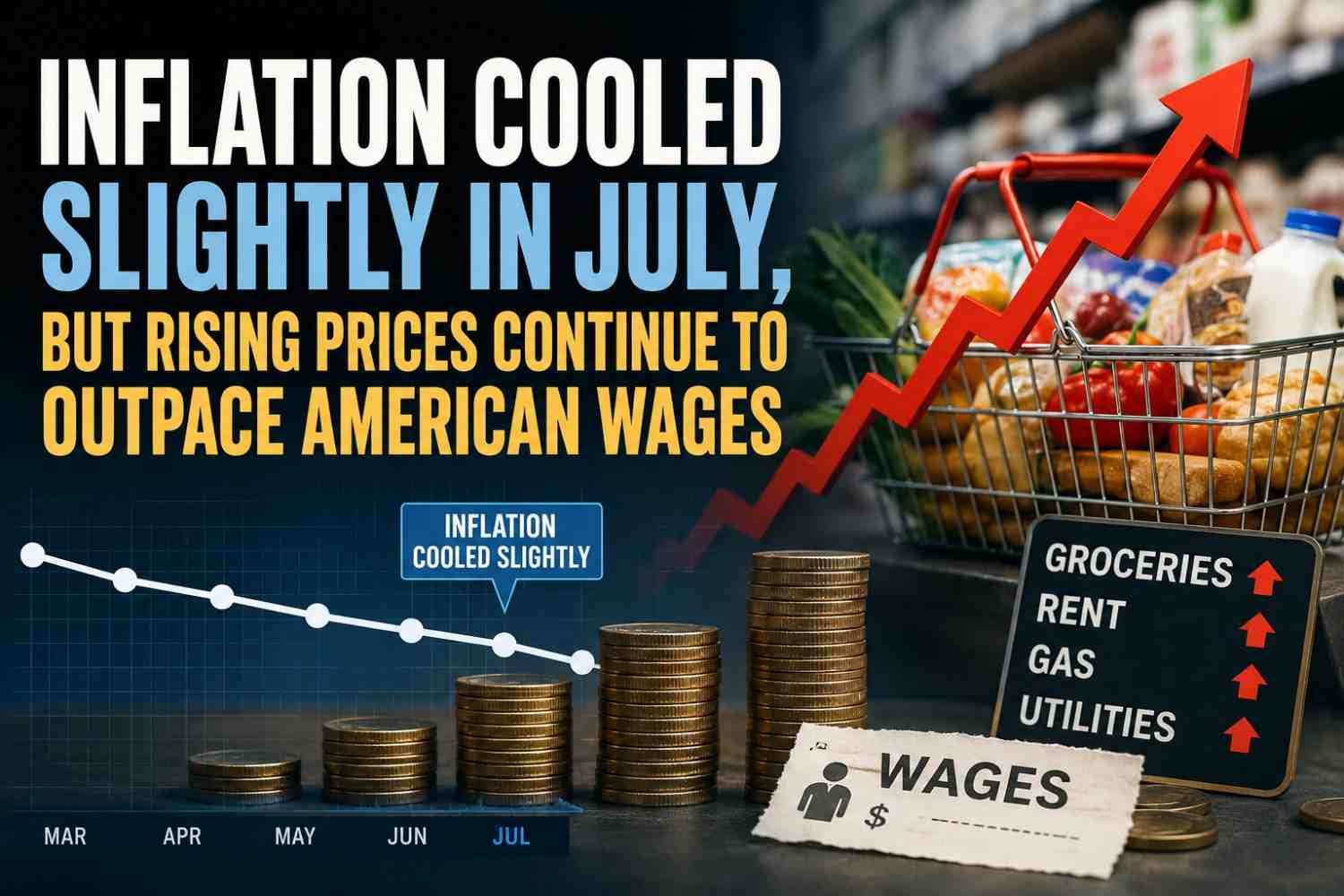
American consumers got a modest dose of good news this week as the government’s latest inflation report showed price growth cooling for a second straight month, even as the overall cost of living remains stubbornly elevated and outpaces what most workers are bringing home in their paychecks.
The Consumer Price Index rose 0.1% in July on a seasonally adjusted basis, the Bureau of Labor Statistics reported, matching Wall Street’s expectations and pushing the annual inflation rate down to 3.4%, from 3.5% in June. Core inflation, which strips out volatile food and energy costs, ticked up 0.2% for the month and now sits at 2.5% year-over-year.
A Cooling Trend, But Not a Cool-Down
Economists had widely expected the July reading to come in roughly where it landed, and the report’s numbers were described as being right in line with Dow Jones consensus forecasts. Taken together with a similarly tame reading in June, the data suggests that the sharp, energy-driven price surge that hit consumers earlier this year is beginning to lose momentum.
Still, inflation remains well above the Federal Reserve’s long-standing 2% annual target, a gap that has persisted for years and continues to shape how the central bank approaches interest rate policy. At its July meeting, the Federal Open Market Committee voted 9-3 to hold rates steady, with all three dissenting votes favoring a hike rather than a cut — a signal that some policymakers remain uneasy about inflation’s staying power.
Markets, however, appear to be growing more confident that the Fed will stand pat when it meets again in September. Just weeks ago, traders had priced in a strong likelihood of a rate increase at that meeting. That calculus has shifted following news of a net job loss in July and continued volatility in energy markets, both of which have tempered the urgency around tightening monetary policy further.
Wages Losing Ground
For many households, the headline inflation figure tells only part of the story. Average hourly earnings slipped 0.2% from a year earlier, according to the BLS, meaning wage growth — running at roughly 3.2% — continues to trail the pace of price increases. That gap has now persisted for four consecutive months, according to Heather Long, chief economist at Navy Federal Credit Union, who described it as “the key issue” facing middle- and lower-income Americans.
In practical terms, that means even as inflation cools on paper, many workers are seeing their paychecks buy less than they did a year ago — a dynamic that helps explain why affordability concerns remain a dominant theme in public opinion surveys, even during periods when official inflation metrics are trending in a more favorable direction.
What’s Driving Prices Higher
Energy costs remain a central storyline behind this year’s inflation pressures. Brent crude oil topped $90 a barrel this week, while U.S. crude approached $84, driven in part by ongoing tensions tied to the conflict with Iran. The national average price for regular gasoline climbed back above $4.03 a gallon even as the July report itself showed gas prices falling 2.9% for the month — a reminder that fuel costs remain highly sensitive to geopolitical developments that can shift quickly.
Electricity prices were largely flat, rising just 0.1% in July, though they remain up more than 4% over the past year. On the food side, prices increased 0.1% overall for the month, with groceries edging down slightly while the cost of dining out continued to climb, up 0.3% monthly and more than 3% annually.
Other categories showing increases in July included medical care, airline fares, communications, education, and recreation — a broad mix that illustrates how inflation pressures, while easing overall, are still touching multiple corners of household budgets simultaneously.
What Comes Next
The next inflation snapshot, covering August, is scheduled for release on September 11 — just days before the Fed’s next policy meeting. That report will likely play an outsized role in determining whether the central bank continues to hold rates steady or shifts course, particularly if energy markets remain volatile amid ongoing conflict in the Middle East.
For now, the July data offers a cautiously reassuring signal for policymakers hoping to avoid reigniting inflation without further squeezing a labor market that has already shown signs of softening. For everyday Americans, though, the relief may feel modest at best, given that price levels remain well above where they stood before this year’s energy-driven spike began — and wages have yet to catch up. Next Article