A Rare Double Feature Lights Up the Sky Today
Skywatchers across the United States are in for a treat today as a partial solar eclipse sweeps across 26 states, offering millions of Americans a chance to see the Moon take a visible bite out of the Sun. While the full spectacle of totality will belong to viewers across the Atlantic — with Greenland, Iceland, and northern Spain experiencing a total solar eclipse, the first visible from mainland Europe since 1999 — the United States will still see a widespread and dramatic partial eclipse stretching from Alaska through the northern states and into New England.
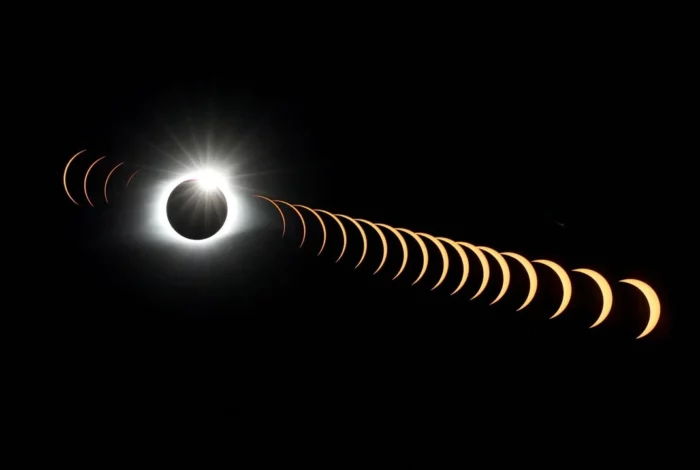
The eclipse occurs because the Moon’s outer shadow, known as the penumbra, sweeps rapidly across the northern reaches of North America, even though the darker central shadow, or umbra, misses the continent entirely. That means there is no location within the US where the Sun will be fully obscured, and no “ring of fire” effect either, since this is not an annular eclipse. Instead, viewers in the eclipse’s path will see a crescent-shaped Sun as the Moon partially covers it.
When and Where to Watch
Because the shadow moves quickly and eclipse timing shifts even between cities within the same state, officials and astronomy experts are urging viewers to check exact local timing using a location-specific eclipse calculator rather than relying on generalized regional estimates. The percentage of the Sun that appears covered will also vary significantly depending on location, with areas farther north and west along the eclipse’s path generally seeing a larger portion of the Sun obscured.
Safety remains the top concern for anyone hoping to view the event directly. Experts continue to stress that looking at the Sun without certified eclipse glasses, even during a partial eclipse, can cause serious and permanent eye damage. Regular sunglasses, no matter how dark, do not provide adequate protection. NASA and other astronomy organizations recommend using eclipse glasses that meet international safety standards, or alternative methods like pinhole projectors, for anyone hoping to safely observe the event.
A Second Show After Dark
As if one celestial event weren’t enough, tonight also brings the peak of the Perseid meteor shower, widely regarded by astronomers as the most reliable and prolific meteor shower of the year. This year’s timing is especially favorable: the New Moon coincides almost exactly with the shower’s peak, meaning there will be little to no moonlight to wash out the night sky, giving stargazers some of the best viewing conditions in recent years.
The Perseids are produced by debris left behind by comet Swift-Tuttle as Earth passes through the comet’s trail each summer. Under ideal, dark-sky conditions away from city lights, viewers can typically expect to see dozens of meteors per hour during the shower’s peak. Astronomy experts recommend heading away from urban light pollution, giving your eyes at least twenty to thirty minutes to adjust to the darkness, and watching from late evening into the early morning hours for the best chance of catching multiple shooting stars.
A Packed Week for Skywatchers
Today’s eclipse and meteor shower peak cap off what astronomy enthusiasts have described as one of the most eventful stretches of the year for skywatching. In the days surrounding the eclipse, early risers at mid-northern latitudes — including cities like New York — have also had the chance to catch a rare alignment of multiple planets visible in the pre-dawn sky, adding to the sense that this particular week offers something for nearly every kind of sky enthusiast.
For those hoping to catch both events today, the recommended approach is straightforward: view the partial eclipse during the day using proper eye protection, then head back outside after dark, away from bright city lights, to catch the Perseids as they streak across a moonless sky. Local astronomy clubs, science museums, and planetariums in many cities are hosting viewing events, offering an easy and safe way for families and first-time skywatchers to take part in both spectacles without needing specialized equipment.
Whether viewed from a backyard, a local park, or an organized public event, today’s combination of a partial solar eclipse and the Perseid peak offers a rare reminder of how often the sky rewards those who simply take the time to look up. Next Article